Friday, April 22, 2011

Tidbit #25 - April 22, 2011

It's so weird when it happens, isn't it?

WHOA! Anyone else feel déjà vu there? I sure did, and it made me wonder: What makes déjà vu happen?

Question: What causes déjà vu?


Answer: By definition, déjà vu is "the feeling that you have experienced a situation before even though you know you haven't" (Re: science.howstuffworks.com).

Furthermore, there are different types of déjà vu that someone can have. Precognitive experiences are one type, in which someone feels like they know what's going to happen next, and that happens. There are many other types that we won't get into, seeing as this tidbit only focuses on what makes déjà vu occur.

So, I went ahead and searched up déjà vu on howstuffworks, and found a neat little article (or big article, rather). You can look at the article I viewed here.
"[Many scientists] have since determined that the medial temporal lobe is involved in our conscious memory. Within the medial temporal lobe are the parahippocampal gyrus, the rhinal cortex and the amygdala. John D.E. Gabrieli at Stanford University found in 1997 that the hippocampus enables us to consciously recall events. He also found that the parahippocampal gyrus enables us to determine what's familiar and what isn't (and without actually retrieving a specific memory to do it)." (Re: science.howstuffworks.com)
That wasn't a big wall of text, but it certainly had some big words! Let's break it down into my own summary:

Many parts of the brain are involved in déjà vu. Our conscious memory is where it generally happens, but a part of our brain called the hippocampus allows us to recall memories. Something called our parahippocampal gyrus (pretty much another name for the stuff around the hippocampus) also plays a role in déjà vu by encoding our initial memories so we can think we remember them later on.
I also found a neat article on Wikipedia (where else?) that really shone the light, if what you've already read didn't:
The similarity between a déjà-vu-eliciting stimulus and an existing, but different, memory trace may lead to the sensation. Thus, encountering something which evokes the implicit associations of an experience or sensation that cannot be remembered may lead to déjà vu.
Basically, that stated our condensed answer:

 Déjà vu happens when our brain associates an existing memory with a new one.

Tuesday, April 19, 2011

Tidbit #24 - April 19, 2011

Another great from Feldman's Imponderables series:

Question: Why is $ the sign for the US dollar?


Answer: I remember looking up Feldman's book online and finding this and thinking that I had to show this to everyone at the blog, but I can't seem to find it now, so I can't remember exactly the citation except the very condensed answer, so sorry about that: short tidbit!

The $ sign is thought to be a twist on the sign for the Spanish Peso.

Tidbit #23 and Announcement - April 19, 2011

Before I begin, I'd like to make an announcement:

From this point onward, I have become too busy to post a new tidbit every day. Therefore, in most cases, I will be posting two tidbits every two days instead of the traditional one a day I started with. It's just a lot more convenient for me, and maybe for you guys, too.

Anyways, let's get on with the tidbit.

Remember first grade? Your hardest tests were timed addition tests (7+8, anyone?), recess still existed, and white glue was your duct tape: it could fix anything. You probably never bothered to wonder why the sticky stuff inside the bottle would always be able to slide right down the bottle and not get stuck.

Question: Why doesn't glue stick to the bottle?


Answer: Our friends at Answers.com have this one covered, as usual:
Another great and puzzling question. Why doesn't glue stick inside of the glue bottle?
Glue on paper: As the glue connects with oxygen it becomes sticky and if left to dry in this oxygen it becomes hard and keeps multiple things together. 
Glue inside the bottle: Glue doesn't stick inside the bottle because the chemicals within the glue is triggered by oxygen (what we breathe) so when the glue bottle is opened it triggers the chemicals to make it sticky. That's why if a bottle if left out with no cap the glue becomes quite hard. (Re: Answers.com)
So, what's our summary of the text wall?

Normally, glue sticks to paper because the chemicals that make it up become sticky when it crosses paths with oxygen, and dries after awhile and becomes strongly attached to whatever you attached it to. However, if glue is inside the bottle, oxygen can't get to it, and therefore it remains nonadhesive until it comes into contact with any type of oxygen in the air.

Here's your condensed summary:

Glue doesn't stick to the bottle because the chemicals in glue only make the glue sticky if it is exposed to oxygen, which isn't inside the bottle.

Sunday, April 17, 2011

Tidbit #22 - April 17, 2011

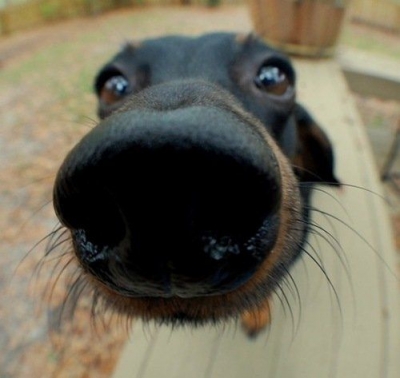
Dogs truly are man's best friend. They're fun to play with, they're loyal, they can be trained, they... have wet noses? What's up with that?

Question: Why do dogs have wet noses?


Answer: Ahh, Answers.com, where would we be without you?
Dogs noses secrete a small amount of mucus which serves two purposes: to help their sense of smell, and to keep themselves cool. The thin layer of mucus helps with the absorption of scent chemicals from the air. In addition, the nose, along with the mouth and the pads of the feet, is one of the locations where dogs bodies release heat. (Re: Answers.com)
Yep, that's right. That wet stuff on your dog's nose is mucus. Granted, it doesn't feel like that, but it is.

Short tidbit today, huh?

Here's your condensed summary for the day:

The wet stuff on a dog's nose is a thin layer of mucus that helps its sense of smell and helps to cool it down.

Saturday, April 16, 2011

Tidbit #21 - April 16, 2011

When you hear the word Calorie, what's the first thing that comes to mind? Food? Bad? I need to stay away from those? That's what most people hear, because a Calorie has come to be known as the standard cause of weight gain, and something to be avoided at all costs. What lots of people don't REALLY know is what a Calorie is, and why it's always capitalized.

So, for today's tidbit, two questions will be integrated into one.

Question(s): What is a Calorie, and why is it capitalized?


Answer: When asked this question, most people end up stuttering and giving an answer like "it's the fat in.. um.." or "isn't it.. um.. the building blocks.. uh.." or just a flat "i don't know." The problem is, even I know this, and it's a simple answer, too, no summary needed.

It's actually a chemistry definition: a calorie is a specific measure of heat. By definition, a Calorie is the amount of heat needed to raise the temperature of 1 liter of water by 1° celsius.


So, that's one question down, but why is it Capitalized Like This?


Well, strictly speaking, there are two different varieties of the heat measurement: calories and Calories. The difference is in the capitalization of the letter c in the word. A little c calorie has the same proportion to a big C calorie as a gram does to a kilogram. (In other words, 1000 calories = 1 Calorie)


If you didn't catch the answers in there, here they are:


A Calorie is the amount of heat needed to raise the temperature of 1 liter of water by 1° celsius.
There are two types of calories: big C and little c. (1000 calories = 1 Calorie)

Friday, April 15, 2011

Tidbit #20 - April 15, 2011

2nd tidbit of the day.

This is also our 20th tidbit in the blog's history!! So sit back and learn your 20th fact.

In light of the upcoming Christian holiday, I'm also making my first seasonal tidbit! Can you guess what it is?

No? Then check out right below for a hint (it's the answer):

Question: What are the origins of the Easter bunny?


Answer: Wikipedia sure has some interesting stuff, wouldn't you agree? Here's what the millions of writers have typed up about the origins of the Easter bunny:
Bringing Easter eggs seems to have its origins in Alsace and the Upper Rhineland, both then in the Holy Roman Empire, and southwestern Germany, where the practice was first recorded in a German publication in the 1500s (early 16th century). The first edible Easter Eggs were made in Germany during the early 19th century and were made of pastry and sugar.
The Easter Bunny was introduced to the United States by the German settlers who arrived in the Pennsylvania Dutch country during the 18th century. The arrival of the Osterhase was considered one of "childhood's greatest pleasures", similar to the arrival of Kris Kringle on Christmas Eve.
According to the tradition, children would build brightly colored nests, often out of caps and bonnets, in secluded areas of their homes. The "O_ster Haws_e" would, if the children had been good, lay brightly colored eggs in the nest. As the tradition spread, the nest has become the manufactured, modern Easter basket, and the placing of the nest in a secluded area has become the tradition of hiding baskets.
Are you a text-wall-skipper? Read the summary:

Summary: Waay back when (we're talking Bronze Age), the bringing of easter eggs seems to have taken its roots in different parts of the Holy Roman Empire. Southwest Germany got with it, too, in the 1500s. The Easter Bunny (or "osterhase"), however, was introduced to the U.S. by the Germans who arrived in the Pennsylvania Dutch country in the 1700s. Tradition said that if children laid brightly colored nests (generally made our of caps or bonnets) in hidden areas of the house, that "O_ster Haws_e" would put eggs in those nests.
Eventually, the process modernized, evolving into the happy-go-lucky bunny and eggs we know of today.
Unfortunately, those delicious Easter eggs weren't part of the easter tradition until the 1800s.
I tip my cap to whoever was able to read that, but to the rest of you, here is your condensed answer:

The Easter bunny seems to have taken its roots in the German settlers (for whom it had been a tradition since the days of the Holy Roman Empire) who came to the U.S. in the 1700s.


And a very happy Easter to everyone visiting tidbitsz.blogspot.com!

Tidbit #19 - April 15, 2011

Oh no! I missed a day!

Well, the good news is, I'll be more than compensating for it: I'll be posting not one, not two, but three tidbits today. How cool is that???

Okay, let's get started:

Have you ever heard anyone use the expression "I got laid last night!"? Did you promptly become angry at that person for describing it so blatantly? Well, you shouldn't have, because most people, although imbued with the knowledge that that expression means having sex, don't know where the term came from and how it was coined.

Question: Why is it called getting laid?


Answer: There are a few possible reasons. I couldn't find the first reason online, but my stepdad (a historian) told me about the first one:

  1. It is said that the term was coined in the early days of the famous (or infamous, rather) Chicago Everlay Club, in which people would.. do their business.. and come out saying that they got "layed," since the club was famous for that. Eventually, the spelling changed, but the name stuck.
  2. Someone on lunaticoutpost.com thinks they know the answer, and I think they might be on to something: "it's hard to have sex standing up"
So, as a condensed answer, what do we have?

Getting laid could have been coined due to either the reputation of the Chicago Everlay Club or the positioning of intercourse when it happens (in most cases).

Wednesday, April 13, 2011

Tidbit #18 - April 13, 2011

I don't know about you, but I find eggs to be an excellent food. They're just so good-tasting however they're made: scrambled, hard-boiled, sunny-side up, they're still the same delicious eggs. They can also be divided into subcategories, which is what we're taking a look into today. What I wanna know is:

Question: What's the difference between brown and white eggs??


Answer: Well, at first, I thought that brown chickens laid brown eggs. (Bear with me on this, I was 7 or 8 when I had this theory.) Then, several months ago, I discovered something at the store: it seemed that the only eggs that were organic were brown. Although I didn't go checking every egg in the store, I thought that was it for awhile, and until I searched the answer, I still thought it. I found a good answer, though, titled and everything!

The Difference Between White Eggs and Brown Eggs
The first and obvious difference is their color, the second is the type of chicken it comes out of, personally I haven't tasted any difference between the two. 
Nutritionally there is no difference, various breeds lay different colors. White eggs are popular with grocery stores visually (clean and fresh looking) and one of the best laying breeds happens to lay white eggs. Restaurants often prefer brown eggs as it is easier to see bits of shell when they fall in the food being prepared. A tiny white bit of shell in a pound of flour is hard to find until somebody crunches it. Yolk color is adjusted by feed contents. 
Really, the only true difference is the one you mentioned, the color. They taste the same, have the same amount of nutrients, everything. The only difference is the genetics of the chicken that laid the egg. 


Note - Many people do not know this, but technically, brown eggs and white eggs have the same shell color - white. The brown you see is an "overlay" of color. Hence, both eggs have white shells - but the brown has an "overlay" of color that makes it a brown color.
Note 2- White eggs are the product of chickens with white ears and chickens with red ears lay other colors including Blue and green. The quality of the egg depends on if you get the egg from a grocery store that has mass produced eggs or from a farmer that lets the eggs run freely. 
The reason you see more white eggs in the stores is because the mass producers will normally use the Leghorn chicken one of the best egg producers it is also a smaller chicken and not as often used as a eating chicken. These chickens have white ears.
(Re: wiki.answers.com Question)

If you just skipped that giant wall of text, let me summarize it for you:

Strictly speaking, there is no difference between them besides, obviously, the color. They taste the same, they have the same nutritional value, everything. I guess the only difference is the type of chicken that lays the egg; in general, chickens with white ears lay white eggs, while chickens with red ears lay different color eggs.

As an added note, my dad told me that whenever he bought brown eggs, he told me he felt a tougher shell. Don't know is this is true, but you never know, right?

So, as a condensed answer (and mind you, this is very condensed) is:

Strictly speaking, the only difference between the two types of eggs is the color and the type of chicken that lays them.

Tuesday, April 12, 2011

Tidbit #17 - April 12, 2011

Anyone up for some Starbucks? I always get a Tall Strawberries n' Cream Frappucino. Mmmm... Milkshakes. But why is it a Tall size if it's so small?

Question: Why is tall coffee the small size?


Answer: This one was tougher to search up than I thought. I found what seems to be the right answer, though:

Originally, most coffeeshops only had two sizes: short and tall, based on not only the amount of drink they held, but by their height. (hence, short and tall) Eventually, as supply and demand grew, so did the drink sizes, and what was once the largest size (tall) became the shortest size, and the name just stuck. You can still order it as a "short" size and you'll get the same size, but isn't it sad how demand has grown like that?

So, as a condensed answer, we have:

Tall coffee is the small size because, due to increasing demand for more drink, the large (tall) became the small, and the name stuck.

Monday, April 11, 2011

Tidbit #16 - April 11, 2011

I don't know about you, but when I come home after a long day, the first thing I have to eat is a peanut-butter and jelly sandwich, better known as PB&J action. It really hits the spot, the mixture of sweet and salty and peanut-buttery, with the taste of the bread... Anyways, I'm getting off topic. When I was having my sandwich today, I was thinking: "What's so different about jams, jellies and preserves?" So, naturally, I posted it on here.

Question: What's the difference between jam, jelly and preserves?


Answer: Luckily, we have TLC's cooking website to help us out. Someone asked on the forum and we've got a nice answer:

Jelly, jam and preserves all contain fruit in some form, mixed with sugar and pectin; the difference between them is caused by the form of the fruit in the substance:

  • In jelly, the fruit comes in the form of fruit juice.
  • In jam, the fruit comes in the form of fruit pulp or crushed fruit (and is less stiff than jelly as a result)
  • In preserves, the fruit comes in the form of chunks in a syrup or a jam.
Pectin is a type of carb that your stomach can't digest and that is found in a fruit's cell walls. "When heated in water with sugar, it gels, giving jelly, jam and preserves their thickness.

So, what do we have here?

Jelly, jam and preserves differ in the form that the fruit takes in the container.

Sunday, April 10, 2011

Tidbit #15 - April 10, 2011

Lots of you have probably heard of David Feldman's puzzling series of books called "Imponderables," all with different titles. As a reminder, I have not utilized any of his imponderables.. Until now. I'm using one of his most famous questions, and summarizing it in my own words:

Question: How does Aspirin find a headache?


Answer: I looked it up, and I found someone on uh.edu who found his book and typed up Mr. Feldman's answer:
Try that aspirin question: I always thought aspirin just entered the blood and reduced pain wherever the blood went. Aspirin does enter the blood, but then it acts selectively on pain and inflammation. Not 'til the 1970s did pharmacologists figure out how it did that. Aspirin attacks a certain fatty acid that serves as an early warning system by increasing the sensitivity of pain receptors. Aspirin turns those painful warning bells off.
And, as always, my condensed summary:
When you take Aspirin, the pill dissolves into the blood and attacks a fatty acid that causes pain receptors to tell the body something's wrong, shutting it down.

Saturday, April 9, 2011

Tidbit #14 - April 9, 2011

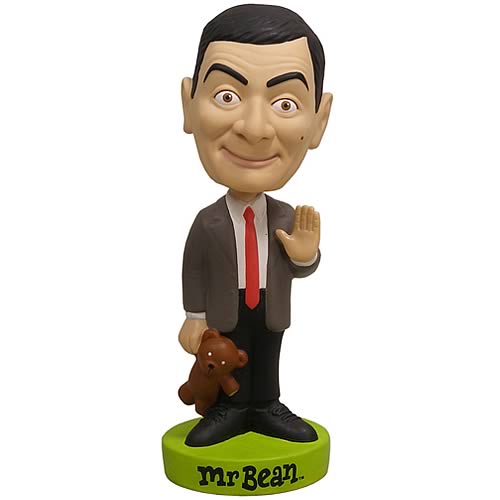
Aren't bobbleheads peculiar? They have bobbleheads of so many different people, particularly sports players. Take all of those different bobbleheads of the Yankees or the Dodgers. Why do they make those? Where did they originate? When and why did they become so famous?

Question: Where did the bobblehead originate?


Answer: An easy-to-find answer, found on (what else?) Wikipedia.


  • "The earliest known reference to a bobblehead is thought to be in Nikolai Gogol's 1842 short story 'The Overcoat,' in which the main character's head was described as 'like the necks of plaster cats which wag their heads.' The modern bobblehead appeared in the 1950s. By 1960, MLB had gotten in on the action and produced a series of paper-machié bobblehead dolls, one for each team, all with the same cherubic face." (Re: Wikipedia)
  • As an added fact, bobbleheads were still available before the modern type was introduced in the '50s. In fact, there was a bobblehead created in the 1920s of a New York Knicks player.
So, what do we have as a condensed answer?

Bobbleheads are thought to have been introduced in Nikolai Gogol's 1842 short story "The Overcoat."

Friday, April 8, 2011

Tidbit #13 - April 8, 2011

The sound of rain is among the most beautiful sounds in our world. People love to sit inside with all the lights off and listen to its beautiful sound. However, some people like to utilize it to have a pool right outside the house, and they run out with a swimsuit on to dance around in it. They're probably having too much fun to wonder why it doesn't hurt them, falling 10,000 feet from the sky.

When you think about it, the question can be quite confusing,

Question: Why doesn't rain hurt?


Answer: Only one true answer, straight and simple:

                 Quoted: "For the same reason that a person jumping out of an airplane at 20,000 feet doesn't hit the ground with the same speed as a person jumping out of a plane at 10,000 feet. A falling object's speed continues to increase (because of the force of gravity) until the force of air resistance exactly cancels gravity. This occurs at a speed called the 'terminal velocity' for that object and depends on the object's mass and shape. That's why snow falls much more slowly than rain and why a feather falls slower than a rock with the same mass. The terminal velocity for a person is about 120 MPH." (Re: newton.dep.anl.gov)

                 Summarized: When a raindrop is released from a cloud, the force of gravity will pull it downwards, increasing its speed. The reason the speed doesn't increase indefinitely until it reaches an object that will stop it is because all the time it's falling, the air is pushing back on it, increasing the pressure at which it pushes all the time gravity pushes it down. Eventually, this "struggle" between gravity and air will equalize, and the rain will continue to fall, but it will not speed up, causing it to hit you softly with its pitter patter.

So, what do we have as a condensed summary?

When rain falls, the force of gravity and air pressure equalize its velocity, keeping it from traveling faster than the speed we know it to fall.

Thursday, April 7, 2011

Tidbit #12 - April 7, 2011


Like, what's up with, like, people's speech nowadays? Like, it's like, like, all of their, like, sentences are, like, supplemented with, like, the word like. Like, why do you think that is?

Question: Where did the pause in speech, "like", come from?


Answer: There could be a few reasons:


Shaggy and Scooby:
Like, enthusiasts of the word like.
(And quintuple-decker sandwiches)
  1. Someone in Yahoo! Answers was so kind to give us a nice, detailed answer: "'Like' is a 'filler' word that has kind of crept into the English language over the past decade or so. There isn't really anything you can say instead of like; hence the 'filler' term. A 'filler' word is just something you use out of habit, really. Same with 'umm' and 'uhhh' etc, they have no meaning and no real substitutes, they are just there for the sake of being there." (Re: Yahoo! Answers)
  2. Another great Yahoo! Answer: "The word 'like' has been used as a postponed filler ('going really fast, like') from 1778; as a presumed emphatic ('going, like, really fast') from 1950, originally in counterculture slang and bop talk." (Re: Yahoo! Answers) The rest of this article seemed too long and tedious to read, so I summarized it and made it answer #3:
  3. The word "like" might also have originated from some famous media. For example, it might be a fad following Frank Zappa's hit song "Valley Girl", from 1982. The TV character Maynard G. Krebs from the series "Dobie Gills" (1959-1963), who used the expression a lot, might have brought it to prominence. Shaggy and Scooby from "The Adventures of Scooby Doo!" might have had something to do with it as well: "ZOINKS! LET'S, LIKE, GET OUTTA HERE, SCOOB!" Anthony Burgess' 1962 novel A Clockwork Orange had the narrator using his teenage slang: "I, like, didn't say anything." 
  4. Finally, it could have originated in Scotland in R.L. Stevenson's 1886 novel Kidnapped: "What's like wrong with him?" (p.193)
Well, what have we got here as a final answer?

It could have originated from lots of famous media, such as the TV show "Dobie Gills", Frank Zappa's song "Valley Girl", Shaggy and Scooby from "The Adventures of Scooby Doo!", Anthony Burgess' A Clockwork Orange, or R.L. Stevenson's 1886 novel Kidnapped.

Want it more condensed than that?

It most likely originated from a type of famous media. 

Wednesday, April 6, 2011

Tidbit #11 - April 6, 2011

I was just recently hired at my local amusement park, Six Flags Magic Mountain. I was all jazzed when I found out where I was working, because I was working at a place called Suzette's Bakery, which was the place where they make funnel cakes! I thought about how tasty-smelling my job was going to be, working with funnel cakes every day. But then I got to wondering after I served my first cake, "Why is it called a funnel cake?" So, naturally, I searched it up.

Question: Why is it called a funnel cake?


Answer: I searched it up, and I found a couple possible solutions:


  1. "It is made from an oil funnel like the one you use in your garage." (Re: WikiAnswers)
  2. The batter that is fried to create the funnel cake has to be poured out in a certain indistinguishable pattern to create that uneven plaid-checkered pattern. My guess is that, in most cases, you use any type of funnel to pour the batter in that uneven pattern, so as to get more control over the shape instead of having it just be a plain circle. (In a nutshell, using a funnel to pour the batter out) Although this might just be the original or most common way people make their funnel cakes, because my work area uses a pitcher to pour the batter into the fryer.
So, what do we have here?

Our delicious fried treat is so aptly named because a funnel is used to make one, in most cases.

I could have guessed that!

Tuesday, April 5, 2011

Tidbit #10 - April 5, 2011

"Ohh.. My head. I feel like there are people hammering my skull in. I really shouldn't have drank so much last night."

If you've ever had an overnight in Vegas, you know what that's like. Hangovers are the worst immediate pains of drinking, and many people say that it's karma getting back at you. Unfortunately, during your hangover, you're in too much pain (or too numbed by the Aspirin) that you never think about why it's called a hangover; only sober people do.

Question: Why is it called a hangover?


Answer: See, this question doesn't have any confusing etymology or disputes between what it was. That's why it was so easy to find out. Wikipedia magic, my friends.

Anyways, strictly speaking, the word hangover was used in the 19th century to describe unfinished business (i.e. something you haven't done that you hang over for later). In 1904, people began using the term to mean directly: "something left over from the night before" -- in this case, the leftover party.

So, basically, a hangover is so named because people began using the term to refer to the "leftovers" of the party-that is, the remnants of it.

Monday, April 4, 2011

Tidbit #9 - April 4, 2011

Pop! Pop! Pop! Pop! Pop! Pop! Pop! Mmmm.. That's the stuff. The sound of popcorn popping is among one of the more pleasurable parts of the tasty snack. One of the less pleasurable aspects is waiting for it to finish popping. You might have wondered what exactly makes the popcorn pop.

Question: Why does popcorn pop?


Answer: Three elements of a popcorn kernel contribute to the making it that delicious treat: percentage of water, waterproof shell, and a starchy center.

When you heat the popcorn kernels up, the water inside the shell begins to steam.

If the shell is waterproof, then every single kernel is like a tiny pressure cooker. The starch in the kernel becomes something of a gelatin-like substance because of this.

Eventually, the pressure inside of the shell becomes too much for it to bear, and it bursts: pop!

In a split second of this happening, the water steam expands, causing the gel substance to expand and harden into an airy foam.


Basically, in every kernel of popcorn, the gel-starch expands and cools within milliseconds, causing it to solidify. That solidified product is our popcorn. Pop!


As a side-note, most people don't like the taste of just the pure popcorn starch, so many companies add in things like butter, sugar (for kettle corn), or processed cheese fuzz. The odd thing is, without all of these additives, popcorn is one of the healthiest snacks you can put into your body.

Sunday, April 3, 2011

Tidbit #8 - April 3, 2011

Food can be one of the most pleasurable aspects of our day. And why? Because we all like the taste. There are entire reality shows (Top Chef, anyone?) based on food and its taste. But not everyone who tastes food knows how we taste it.


Question: How do we taste food?


Answer: If you know anything about the nervous system, then you should know that it's based on nerves. Your senses are caused by nerves, particularly specially made neurotransmitters. Your sense of taste is caused by (what else?) your tongue.

On the surface of your tongue are relatively 9000 different sensory receptors (called taste receptors) that pick up taste, also called taste buds. Different areas of the tongue correspond to different tastes, as shown in the diagram to the left. Speaking definitively, every taste bud on your tongue picks up the different chemicals in the food you eat and sends electrical signals through the neurons to the taste processing center of the brain, causing your food's taste.

By the way, all of those regions on the tongue diagram above which correspond to those tastes send more intense signals to the brain when the food you eat has chemicals that taste that way. (Basically, they taste stronger in those areas of the tongue)

Saturday, April 2, 2011

Tidbit #7 - April 2, 2011

It's great, isn't it? Your fingers are feeling rather uncomfortable, until... pop! In that little noise is the answer to your pain. It hurts for a split second, and then it's gone, along with your discomfort. So how does this process work? How do we crack our knuckles?

Question: What happens when we crack our knuckles?


Answer: There are a few possible answers to this question:


  1. I knew a possible solution to this question before I began researching. I had heard all about what it was. I had heard that it was air pockets formed in between your knuckles, which you pop, causing that beautiful noise.
  2. An article on Kidzworld.com states that "when you crack your knuckles, you're essentially pushing the joint into or out of its normal position. A lubricant called synovial fluid (SF) is found between the knuckles, and when you crack them, you pull the bones apart, reducing the SF pressure, which quickly form bubbles which expand and burst, causing the pop! (Re: Yahoo! Answers question)
  3. Another explanation from How Stuff Works explains that this bubble in your knuckle forms during a process called "cavitation". It takes roughly half an hour after you've cracked your knuckle for the gas to go into the SF, creating a bubble for you to pop! (Re: Yahoo! Answers question)
So, we have three answers. All of them point to the same thing:

Our knuckles "crack" when air bubbles in between them burst from pressure.

Friday, April 1, 2011

Tidbit #6 - April 1, 2011

Question: How do DVDs work?


Answer: Yeah, you've thought about it before. You've popped a movie into the player and thought about how amazing it was that that little disk could play entertainment for you.

Strictly speaking, a DVD is just a CD with more space on it. The data on the disk is encoded in little valleys and bumps on the surface. The reason you can't feel those little imperfections on the surface is because during their production, they're covered with a few layers of polycarbonate plastic.

A scanning-electron-microscope image of a DVD. See the
bumps? That's your movie. (PC: optics.rochester.edu)
You can't see them, either, because a reflective layer (which I assume is the back of the DVD that we know so well) is put over them, covering them.

Essentially, the data on a DVD is bundled into an extremely long, condensed spiral of data. Your DVD player is designed to read the bumps on the spiral of the DVD.


So your DVD is basically a prettied-up coiled string of data with plastic around it. Doesn't sound all that fancy, right? It's actually more complicated than I summarize it to be, as you've already found by reading above.

Just a heads-up: The string is something like 740 NANOmeters thick. And just letting you know, 1 meter is 1,000,000,000 nanometers. The wavelength of red light is 650 nanometers. So your DVD's data is only slightly thicker than a wave of light. That's really small!

If you want to learn more about DVDs and how they work, click here.