Showing posts with label how stuff works. Show all posts

Friday, April 29, 2011

Tidbit #32 - April 29, 2011

This is for all my high-schoolers out there who don't understand it; I know I've thought about it before:

Question: How the heck does a grade curve work, anyways?


Answer: Man, eHow is useful. I searched up the question and it brought me a quick answer through this link:
The bell curve is a method in which the instructor of the class assigns grades on a relative basis, rather than one of absolute value. They do this most often by assigning a bell curve, which is a way in which all grades are accounted for. Interestingly, if a few students score perfectly on the absolute scale, it can create a curve that isn't much different than if the test had been scored in the usual manner. For this reason, many instructors grade their tests on the absolute basis and decide afterward whether to curve based on performance.
How Curving Works
When it comes to the pure use of bell curving, the instructor decides at the outset a number of factors that may seem unfair to the uninitiated. They will assign a grade to the middle of the curve (the highest point, and therefore the most common grade in the classroom), which will usually be a C. They will then assign a certain percentage of students to the high end, and a certain percentage to the low end, with each grade along the way receiving a certain share of the students. Statistically speaking, this method of grading is sound, and usually produces results that are indeed fairer than absolute grading, which fails to take into account any shortcomings on the part of the instructor.
Another Common Method
As many instructors fail to see the fairness in the traditional bell curve system, they use another method that has surpassed bell curving in terms of overall popularity and frequency of use. This method is a bit simpler. The instructor grades all the tests on the absolute grading system. He then takes the highest grade in the class (let's say it was a 93). Seven points separate the highest grade in the class from the highest possible score. The instructor will thus add seven points to everyone's score. Much as with the bell curving system, this method is undermined if the highest score is a 100.
I'm not gonna add a summary on this one (high schoolers, you know that adolescent laziness), but here's your condensed answer:

 There are two types of grade curves. One works by using a relatively average grade to the middle of a scale and placing students' grades accordingly. In the other way, the instructor takes the highest grade in the class (the one that "sets the curve"), and makes the assignment out of that many points.

Wednesday, April 27, 2011

Tidbit #29 - April 27, 2011

I've decided that tonight, I'll be ridding my phone of all stored, unanswered questions, because it's getting irritating to have to read through all of them. So, tonight I'll be posting and sharing 6 tidbits with you, including the one on the moon and this one.

Okay, so this tidbit is for all of my guys (or most of them, anyways), since most girls already know the answer. I learned the answer to this question the other day, and it's a pretty neat system, so I figured I'd write about it:

Question: How do they put on acrylic nails?


Answer: While searching for this answer, I stumbled upon a website called enotes.com. On enotes, I found an entire article on acrylic nails and how they're put on, so here you go:

Raw Materials
Monomer liquid
Artificial nail enhancements are made of acrylic plastic. Acrylic is the generic name given to the type of plastic made from a chemical called methacrylate. There are many types of acrylic resins based on different types of methacrylate molecules, but their chemistry is similar. The acrylic used in sculpted nails is formed by the reaction of a monomer liquid with a polymer powder. The monomers ("mono" meaning "one") contained in the liquid are microscopic chemical units which react together when mixed with chemicals in the powder. The monomers combine with one another in a head to tail fashion to form long fibers. These long chains of connected monomers are called polymers ("poly" meaning "many").
Polymer powder
A powdered polymer is then blended with the liquid to adjust the consistency of the plastic. The powdered polymer typically used in acrylics is polyethylmethylmethacrylate (PMMA). PMMA yields a very hard inflexible plastic, but it may be blended with softer polymers to improve its flexibility. When the polymer powder and monomer liquid are mixed, the polymer fibers react in a process known as crosslinking, forming a rigid netlike structure. The polymer strands will eventually dry to form a hard resin that can be made to resemble a fingernail.
Resin modifiers
Other ingredients are added to the monomer liquid and the polymer powder to control the properties of the resin. Crosslinking agents are used to hook the polymer chains together to make the plastic more rigid. The most common is ethylene glycol dimethacrylate. The polymer powder also carries an initiator, which starts the reaction that links the monomers together. A common initiator is benzoyl peroxide (BP), the same ingredient used in acne creams. When the liquid and powder are mixed together and applied to the client's fingers, the BP molecule is capable of exciting or energizing a monomer. Once energized, the monomers join together to form a polymer. Catalysts are also added to the formula to control the speed by which the initiator activates the reactions. A relatively small amount of catalyst is required to do the job, typically about only 1% of the monomer. Chemical inhibitors are added to the liquid monomer blend to prevent the monomers from reacting together prematurely, which turns the liquid into an unusable gel. Inhibitors help prolong the shelf life of the monomer solution. Plasticizers are used to improve resin performance. These liquids help lubricate the polymer chains so they are better able to resist breaking caused by stress.
Misceilaneous ingredients
A variety of ingredients are added to complete the resin. Dyes and pigments may be included to alter the resin's appearance. For example, titanium dioxide, a pigment commonly used in house paint, is used to whiten the nail and create a more natural appearance. It is also used to create special color effects like the white nail tips used in French manicures. Other colorants are added to give the polymer a pinkish or bluish color cast; these shades give a pleasing color to the nail bed. Flow agents are added to help control how polish spreads on the surface of the resin. Finally, color stabilizers are used to prevent yellowing. These materials absorb ultraviolet light that can cause discoloration of the resins.
Design
Every company that produces acrylic nail kits uses the same basic chemistry. However, each has designed its own formula with its distinct advantages and disadvantages. The real design work in creating acrylic nails is done by the nail technician. Each set of sculpted nails has its own idiosyncrasies which must be taken into account when designing the acrylic nails. In this sense, the technician designs the shape of the nail based on the requirements of the client.
The Manufacturing Process
Sculpted acrylic nails are not manufactured on an assembly line by a machine. Instead, as the name implies, they are "sculpted" by a nail technician. Each handcrafted nail is formed one at a time using a process which consists of the following steps: cleansing, priming, mixing, sculpting, and finishing.
Cleansing the nail
1 Before the new nail can be sculpted, the natural nail must be properly prepared. A nail bed cleanser is used to thoroughly clean the surface of the nail. These cleansers are typically solvents such as isopropyl alcohol, which dissolve oils and grease from the surface of the nail. They will also remove bacteria from the area to help reduce the chance of infection. Care must be used when applying these solvents because they may dry out the skin surrounding the cuticle. This occurs because the solvents also remove the skin's own natural moisturizing oils.
Priming the nail
2 After the nail bed has been cleansed, a primer is applied to the nail bed to make sure the acrylic will adhere properly. Primers are available in two types, non-etching and etching. The non-etching type works like double-sided tape; one side of the primer is very good at sticking to the natural nail, and the other end is equally attracted to the acrylic polymers used in the artificial nail. The etching type of primers are acids, such as methacrylic acid, which actually dissolve a thin layer of the nail itself. This etching process allows the acrylic to adhere to the nail better. The etching primers are more commonly used than non-etching. There is some debate regarding the proper use of etching primers; some chemists argue that the primer should dry thoroughly before applying the acrylic. Others believe that the acrylic should be applied while the primer is still wet to pull the acrylic deeper into the nail and anchor it more firmly.
Mixing the acrylic resin
3 The resin is made when the acrylic liquid is mixed with the acrylic powder. The nail technician must work quickly with the resin once the liquid and powder are mixed. If not, the resin will harden before it can shaped into a nail and will not be useable.
Sculpting the nail
4 Before the resin is applied, a nail-shaped form is placed over each fingertip in order to hold the resin in place and ensure it takes the correct size and shape. These forms may be made of metalized foil or plastic. One common type consists of a thin metallic foil with an adhesive backing. The form is peeled off a roll (like a label) and carefully affixed to the fingers. The technician then applies the resin to the client's fingertips. The resin is sculpted to look as natural as possible before the resin hardens. The form is then removed.
Finishing the nail
5 After the acrylic dries, the new nail is filed and manicured to shape. Finally, coatings and polishes are used to complete the manicure. As the natural nail grows, further application of the liquid plastic is needed for the acrylic nail to maintain a regular contour. In some cases, an acetate tip is also applied to the end of the nail to provide a stronger base for the layers of acrylic resin. 
(Re: enotes.com article)


Okay, now even I was too lazy to read that enormous wall of text. So, I skimmed through it and found that only four of the bold sections of that article are truly needed to find out the bare answer to our question. Those four sections are italicized AND bold above.

So, here's your summary:

First, the nail is cleansed with a special cleanser. Afterwards, a primer is put on the nail to ensure that the acrylic stays on. (There are two types: the non-etching and etching type; the non-etching type works like double-sided tape, and the etching type actually dissolve a little layer of the nail itself to let the acrylic adhere better) After the nail is primered, "a nail-shaped form is placed over each fingertip in order to hold the resin in place..." Then, the resin is added "and carefully affixed to the fingers." When the acrylic dries, the new nail is filed, manicured, and covered with special polishes to complete it.

So, basically, here's your condensed answer:

The nail is cleansed and primered, and then a technician applies the resin and the acrylic immediately afterwards, filing, manicuring, and covering it with polish to ensure that it looks good.

Sunday, April 24, 2011

Tidbit #26 - April 23, 2011

Bark! Bark! Bark! Bark! Bark! Bark! Isn't it annoying when your dog barks all night? You're trying to get to sleep and its insistent howling and barking gets so aggravating! But then, just a few hors later, the Earth starts shaking! You're too late to realize that your dog was trying to warn you, and too scared to wonder how it was able to try to warn you!

Question: How do dogs sense an earthquake hours before it happens?


Answer: There's a whole website that I found out about based solely on questions just like this. It's called onearthquakes.com, and I found a forum question that asked exactly what we're looking for here. If you don't want to read that whole article, I fished around in the comments and found the answer, no wall of text or summary needed:

"Animals are sensitive to the change in the Earth's magnetic field just before the earthquake." (Re: onearthquakes.com)

Friday, April 22, 2011

Tidbit #25 - April 22, 2011

It's so weird when it happens, isn't it?

WHOA! Anyone else feel déjà vu there? I sure did, and it made me wonder: What makes déjà vu happen?

Question: What causes déjà vu?


Answer: By definition, déjà vu is "the feeling that you have experienced a situation before even though you know you haven't" (Re: science.howstuffworks.com).

Furthermore, there are different types of déjà vu that someone can have. Precognitive experiences are one type, in which someone feels like they know what's going to happen next, and that happens. There are many other types that we won't get into, seeing as this tidbit only focuses on what makes déjà vu occur.

So, I went ahead and searched up déjà vu on howstuffworks, and found a neat little article (or big article, rather). You can look at the article I viewed here.
"[Many scientists] have since determined that the medial temporal lobe is involved in our conscious memory. Within the medial temporal lobe are the parahippocampal gyrus, the rhinal cortex and the amygdala. John D.E. Gabrieli at Stanford University found in 1997 that the hippocampus enables us to consciously recall events. He also found that the parahippocampal gyrus enables us to determine what's familiar and what isn't (and without actually retrieving a specific memory to do it)." (Re: science.howstuffworks.com)
That wasn't a big wall of text, but it certainly had some big words! Let's break it down into my own summary:

Many parts of the brain are involved in déjà vu. Our conscious memory is where it generally happens, but a part of our brain called the hippocampus allows us to recall memories. Something called our parahippocampal gyrus (pretty much another name for the stuff around the hippocampus) also plays a role in déjà vu by encoding our initial memories so we can think we remember them later on.

I also found a neat article on Wikipedia (where else?) that really shone the light, if what you've already read didn't:
The similarity between a déjà-vu-eliciting stimulus and an existing, but different, memory trace may lead to the sensation. Thus, encountering something which evokes the implicit associations of an experience or sensation that cannot be remembered may lead to déjà vu.
Basically, that stated our condensed answer:

 Déjà vu happens when our brain associates an existing memory with a new one.

Tuesday, April 19, 2011

Tidbit #23 and Announcement - April 19, 2011

Before I begin, I'd like to make an announcement:

From this point onward, I have become too busy to post a new tidbit every day. Therefore, in most cases, I will be posting two tidbits every two days instead of the traditional one a day I started with. It's just a lot more convenient for me, and maybe for you guys, too.

Anyways, let's get on with the tidbit.

Remember first grade? Your hardest tests were timed addition tests (7+8, anyone?), recess still existed, and white glue was your duct tape: it could fix anything. You probably never bothered to wonder why the sticky stuff inside the bottle would always be able to slide right down the bottle and not get stuck.

Question: Why doesn't glue stick to the bottle?


Answer: Our friends at Answers.com have this one covered, as usual:
Another great and puzzling question. Why doesn't glue stick inside of the glue bottle?
Glue on paper: As the glue connects with oxygen it becomes sticky and if left to dry in this oxygen it becomes hard and keeps multiple things together. 
Glue inside the bottle: Glue doesn't stick inside the bottle because the chemicals within the glue is triggered by oxygen (what we breathe) so when the glue bottle is opened it triggers the chemicals to make it sticky. That's why if a bottle if left out with no cap the glue becomes quite hard. (Re: Answers.com)
So, what's our summary of the text wall?

Normally, glue sticks to paper because the chemicals that make it up become sticky when it crosses paths with oxygen, and dries after awhile and becomes strongly attached to whatever you attached it to. However, if glue is inside the bottle, oxygen can't get to it, and therefore it remains nonadhesive until it comes into contact with any type of oxygen in the air.

Here's your condensed summary:

Glue doesn't stick to the bottle because the chemicals in glue only make the glue sticky if it is exposed to oxygen, which isn't inside the bottle.

Sunday, April 17, 2011

Tidbit #22 - April 17, 2011

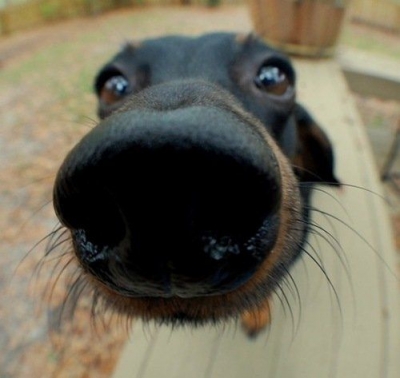
Dogs truly are man's best friend. They're fun to play with, they're loyal, they can be trained, they... have wet noses? What's up with that?

Question: Why do dogs have wet noses?


Answer: Ahh, Answers.com, where would we be without you?
Dogs noses secrete a small amount of mucus which serves two purposes: to help their sense of smell, and to keep themselves cool. The thin layer of mucus helps with the absorption of scent chemicals from the air. In addition, the nose, along with the mouth and the pads of the feet, is one of the locations where dogs bodies release heat. (Re: Answers.com)
Yep, that's right. That wet stuff on your dog's nose is mucus. Granted, it doesn't feel like that, but it is.

Short tidbit today, huh?

Here's your condensed summary for the day:

The wet stuff on a dog's nose is a thin layer of mucus that helps its sense of smell and helps to cool it down.