Showing posts with label etymology. Show all posts

Wednesday, May 25, 2011

Tidbit #34 - May 25, 2011

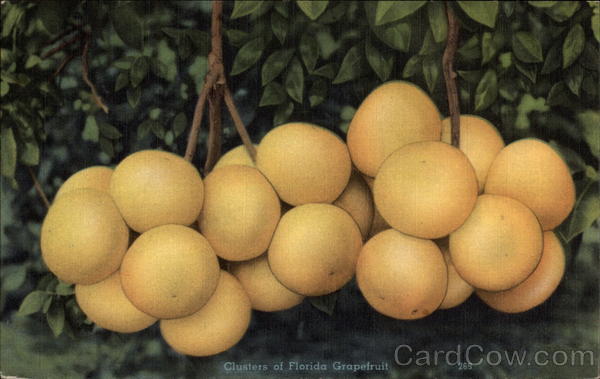
Fruits have some strange names... Especially the grapefruit. Why the weird name? It has nothing to do with the little elliptical fruit... Right?

Question: Why is a grapefruit called a grapefruit?


Answer: Huh.. I learned something new today. (As I strive to do thrice every day) We've got a special source: loc.gov. Here's your quoted answer:
Most botanists agree that the grapefruit is a cross between a Pummelo (see http://pas.byu.edu/pas100/pummelo.htm) and a sweet orange (see http://www.floridata.com/ref/C/citr_sin.cfm.) 
Grapefruit, like all citrus fruit, is a Hesperidum, or a large modified berry with a thick rind.
If you see grapefruit growing on a tree, you will notice that they grow in clusters. It is suggested that these clusters resemble the shape of large yellow grapes and so the fruit was called a grapefruit. Another explanation is that the premature grapefruit looks similar in shape to unripe green grapes.
I wish all of the sites gave condensed answers so I wouldn't have to come up with one. Quoted from loc.gov, here is your condensed answer:

It is believed that the name refers to the manner in which grapefruit grows in clusters on a tree.
Peculiar, isn't it? They're like Goliath's grapes.

Tidbit #33 - May 25, 2011

Hey there, everyone out there!
It's been awhile, hasn't it?
I believe my last post was on the first of this month. I've been up to my eyeballs in work this month, seeing as it's the last month of school before summer vacation! I've accumulated a whole bunch of neat tidbits meaning to put them on my blog, but I've never gotten around to it till now.
So, let's get back to business:

Question: Where did the term "pardon my french" come from?


Answer: Lots of people use this phrase without knowing where it comes from. I searched it up, and I found two different answers on the same website, a new site for us: Google Answers. Here's the first one:

Some English-speakers stereotype the French as permissive about
anything risqué. This was particularly true a hundred years ago when
the phrase took off as an "apology" for swearing. "Excuse my French"
or "Pardon my French" isn't just play-acting that you're speaking a
foreign language. It's also a bit like saying, "I know those words are
naughty - but maybe I could get away with behaving like that in
France, where people are more tolerant of obscenity."
 And here's the second one:
It is thought that the term French is employed in this sense as it already had a history of association with things considered vulgar. As far back as the early 16th century, French pox and the French disease were synonyms for genital herpes, and French-sick was another term for syphillis.  The OED [Oxford English Dictionary] also equates the adjective French with "spiciness", as in French letter for "condom", French kiss (1923) and French (i. e. "sexually explicit") novels (from 1749).
Well, now, I assume that you guys still want condensed answers, correct? Well, wait no longer, here you are:

The term could've taken its roots in people playacting as if they were saying something in another language besides a curse word in English; it also could have originated due to the already existing French names for bad things (i.e. French pox = genital warts)

Friday, April 29, 2011

Tidbit #31 - April 29, 2011

Mmm... If I ever had to cook my food with one oil and only one oil, I would choose olive oil. Olive oil circulated around the ancient Greeks' society; historians say that some Greeks even bathed in olive oil to cleanse themselves. Popeye loved Olive Oyl, too, since she was his girl. Now, I wouldn't bathe in olive oil (or go out with it), but I still wonder whenever I add olive oil into whatever I'm cooking:


Question: Why is it called "extra virgin" olive oil?


Answer: Well, Yahoo! Answers gives us a nice, short, to-the-point explanation:
Extra Virgin olive oil is the oil that comes from the very first pressing of the olives- it has the least impurities and the least amount of processing- no heat or other methods besides pressing was involved in obtaining the oil. (Re: Yahoo! Answers question)
Well, it looks like we've got a short tidbit today! Here's your condensed answer:


Extra virgin olive oil is so named because only absolutely fresh olives are pressed -- without impurities, like a virgin.


They probably add the "extra" in there just for good measure.

Saturday, April 16, 2011

Tidbit #21 - April 16, 2011

When you hear the word Calorie, what's the first thing that comes to mind? Food? Bad? I need to stay away from those? That's what most people hear, because a Calorie has come to be known as the standard cause of weight gain, and something to be avoided at all costs. What lots of people don't REALLY know is what a Calorie is, and why it's always capitalized.

So, for today's tidbit, two questions will be integrated into one.

Question(s): What is a Calorie, and why is it capitalized?


Answer: When asked this question, most people end up stuttering and giving an answer like "it's the fat in.. um.." or "isn't it.. um.. the building blocks.. uh.." or just a flat "i don't know." The problem is, even I know this, and it's a simple answer, too, no summary needed.

It's actually a chemistry definition: a calorie is a specific measure of heat. By definition, a Calorie is the amount of heat needed to raise the temperature of 1 liter of water by 1° celsius.


So, that's one question down, but why is it Capitalized Like This?


Well, strictly speaking, there are two different varieties of the heat measurement: calories and Calories. The difference is in the capitalization of the letter c in the word. A little c calorie has the same proportion to a big C calorie as a gram does to a kilogram. (In other words, 1000 calories = 1 Calorie)


If you didn't catch the answers in there, here they are:


A Calorie is the amount of heat needed to raise the temperature of 1 liter of water by 1° celsius.
There are two types of calories: big C and little c. (1000 calories = 1 Calorie)

Friday, April 15, 2011

Tidbit #20 - April 15, 2011

2nd tidbit of the day.

This is also our 20th tidbit in the blog's history!! So sit back and learn your 20th fact.

In light of the upcoming Christian holiday, I'm also making my first seasonal tidbit! Can you guess what it is?

No? Then check out right below for a hint (it's the answer):

Question: What are the origins of the Easter bunny?


Answer: Wikipedia sure has some interesting stuff, wouldn't you agree? Here's what the millions of writers have typed up about the origins of the Easter bunny:
Bringing Easter eggs seems to have its origins in Alsace and the Upper Rhineland, both then in the Holy Roman Empire, and southwestern Germany, where the practice was first recorded in a German publication in the 1500s (early 16th century). The first edible Easter Eggs were made in Germany during the early 19th century and were made of pastry and sugar.
The Easter Bunny was introduced to the United States by the German settlers who arrived in the Pennsylvania Dutch country during the 18th century. The arrival of the Osterhase was considered one of "childhood's greatest pleasures", similar to the arrival of Kris Kringle on Christmas Eve.
According to the tradition, children would build brightly colored nests, often out of caps and bonnets, in secluded areas of their homes. The "O_ster Haws_e" would, if the children had been good, lay brightly colored eggs in the nest. As the tradition spread, the nest has become the manufactured, modern Easter basket, and the placing of the nest in a secluded area has become the tradition of hiding baskets.
Are you a text-wall-skipper? Read the summary:

Summary: Waay back when (we're talking Bronze Age), the bringing of easter eggs seems to have taken its roots in different parts of the Holy Roman Empire. Southwest Germany got with it, too, in the 1500s. The Easter Bunny (or "osterhase"), however, was introduced to the U.S. by the Germans who arrived in the Pennsylvania Dutch country in the 1700s. Tradition said that if children laid brightly colored nests (generally made our of caps or bonnets) in hidden areas of the house, that "O_ster Haws_e" would put eggs in those nests.
Eventually, the process modernized, evolving into the happy-go-lucky bunny and eggs we know of today.
Unfortunately, those delicious Easter eggs weren't part of the easter tradition until the 1800s.
I tip my cap to whoever was able to read that, but to the rest of you, here is your condensed answer:

The Easter bunny seems to have taken its roots in the German settlers (for whom it had been a tradition since the days of the Holy Roman Empire) who came to the U.S. in the 1700s.


And a very happy Easter to everyone visiting tidbitsz.blogspot.com!

Tidbit #19 - April 15, 2011

Oh no! I missed a day!

Well, the good news is, I'll be more than compensating for it: I'll be posting not one, not two, but three tidbits today. How cool is that???

Okay, let's get started:

Have you ever heard anyone use the expression "I got laid last night!"? Did you promptly become angry at that person for describing it so blatantly? Well, you shouldn't have, because most people, although imbued with the knowledge that that expression means having sex, don't know where the term came from and how it was coined.

Question: Why is it called getting laid?


Answer: There are a few possible reasons. I couldn't find the first reason online, but my stepdad (a historian) told me about the first one:

  1. It is said that the term was coined in the early days of the famous (or infamous, rather) Chicago Everlay Club, in which people would.. do their business.. and come out saying that they got "layed," since the club was famous for that. Eventually, the spelling changed, but the name stuck.
  2. Someone on lunaticoutpost.com thinks they know the answer, and I think they might be on to something: "it's hard to have sex standing up"
So, as a condensed answer, what do we have?

Getting laid could have been coined due to either the reputation of the Chicago Everlay Club or the positioning of intercourse when it happens (in most cases).

Thursday, April 7, 2011

Tidbit #12 - April 7, 2011


Like, what's up with, like, people's speech nowadays? Like, it's like, like, all of their, like, sentences are, like, supplemented with, like, the word like. Like, why do you think that is?

Question: Where did the pause in speech, "like", come from?


Answer: There could be a few reasons:


Shaggy and Scooby:
Like, enthusiasts of the word like.
(And quintuple-decker sandwiches)
  1. Someone in Yahoo! Answers was so kind to give us a nice, detailed answer: "'Like' is a 'filler' word that has kind of crept into the English language over the past decade or so. There isn't really anything you can say instead of like; hence the 'filler' term. A 'filler' word is just something you use out of habit, really. Same with 'umm' and 'uhhh' etc, they have no meaning and no real substitutes, they are just there for the sake of being there." (Re: Yahoo! Answers)
  2. Another great Yahoo! Answer: "The word 'like' has been used as a postponed filler ('going really fast, like') from 1778; as a presumed emphatic ('going, like, really fast') from 1950, originally in counterculture slang and bop talk." (Re: Yahoo! Answers) The rest of this article seemed too long and tedious to read, so I summarized it and made it answer #3:
  3. The word "like" might also have originated from some famous media. For example, it might be a fad following Frank Zappa's hit song "Valley Girl", from 1982. The TV character Maynard G. Krebs from the series "Dobie Gills" (1959-1963), who used the expression a lot, might have brought it to prominence. Shaggy and Scooby from "The Adventures of Scooby Doo!" might have had something to do with it as well: "ZOINKS! LET'S, LIKE, GET OUTTA HERE, SCOOB!" Anthony Burgess' 1962 novel A Clockwork Orange had the narrator using his teenage slang: "I, like, didn't say anything." 
  4. Finally, it could have originated in Scotland in R.L. Stevenson's 1886 novel Kidnapped: "What's like wrong with him?" (p.193)
Well, what have we got here as a final answer?

It could have originated from lots of famous media, such as the TV show "Dobie Gills", Frank Zappa's song "Valley Girl", Shaggy and Scooby from "The Adventures of Scooby Doo!", Anthony Burgess' A Clockwork Orange, or R.L. Stevenson's 1886 novel Kidnapped.

Want it more condensed than that?

It most likely originated from a type of famous media. 
Wednesday, April 6, 2011

Tidbit #11 - April 6, 2011

I was just recently hired at my local amusement park, Six Flags Magic Mountain. I was all jazzed when I found out where I was working, because I was working at a place called Suzette's Bakery, which was the place where they make funnel cakes! I thought about how tasty-smelling my job was going to be, working with funnel cakes every day. But then I got to wondering after I served my first cake, "Why is it called a funnel cake?" So, naturally, I searched it up.

Question: Why is it called a funnel cake?


Answer: I searched it up, and I found a couple possible solutions:


  1. "It is made from an oil funnel like the one you use in your garage." (Re: WikiAnswers)
  2. The batter that is fried to create the funnel cake has to be poured out in a certain indistinguishable pattern to create that uneven plaid-checkered pattern. My guess is that, in most cases, you use any type of funnel to pour the batter in that uneven pattern, so as to get more control over the shape instead of having it just be a plain circle. (In a nutshell, using a funnel to pour the batter out) Although this might just be the original or most common way people make their funnel cakes, because my work area uses a pitcher to pour the batter into the fryer.
So, what do we have here?

Our delicious fried treat is so aptly named because a funnel is used to make one, in most cases.

I could have guessed that!

Tuesday, April 5, 2011

Tidbit #10 - April 5, 2011

"Ohh.. My head. I feel like there are people hammering my skull in. I really shouldn't have drank so much last night."

If you've ever had an overnight in Vegas, you know what that's like. Hangovers are the worst immediate pains of drinking, and many people say that it's karma getting back at you. Unfortunately, during your hangover, you're in too much pain (or too numbed by the Aspirin) that you never think about why it's called a hangover; only sober people do.

Question: Why is it called a hangover?


Answer: See, this question doesn't have any confusing etymology or disputes between what it was. That's why it was so easy to find out. Wikipedia magic, my friends.

Anyways, strictly speaking, the word hangover was used in the 19th century to describe unfinished business (i.e. something you haven't done that you hang over for later). In 1904, people began using the term to mean directly: "something left over from the night before" -- in this case, the leftover party.

So, basically, a hangover is so named because people began using the term to refer to the "leftovers" of the party-that is, the remnants of it.

Tuesday, March 29, 2011

Tidbit #3 - Mar 29, 2011

Question: Why is the first episode of a TV show generally called "Pilot"?


Answer: I searched it up, and I learned that there are a million hypotheses as to why it is referred to as a "pilot" episode.

  1. My stepdad and I were talking about it on the ride to school today, and his guess is that it's because a pilot of an airplane can decide whether the plane flies or not. The metaphor? Well, the pilot is the episode, the plane is the TV show, and whether it "flies" or not is whether it's successful. The "pilot" episode decides whether the show "flies".
  2. "--the first episode of many TV series is called "Pilot" because the episode functions as a pilot for the series, and the writers aren't creative enough to think up a real title. Some show's have played on this, e.g., the first episode of Futurama was entitled 'Space Pilot 3000.'" (Re: WikiAnswers)
  3. "It's a fairly standard term for a small scale test. Most research projects begin with a small pilot study. As it's a test, it's a long established injoke. They're seeing 'how it flies'." (Re: Yahoo! Answers)

Monday, March 28, 2011

Did You Know That?? (Intro/Tidbits #1-2)

Ever wondered about all those little things worth pondering over? Maybe you've wondered why they use that weird symbol for the heart that we've learned means love. Or maybe you've wondered how our brain can make those memories that we're so fond of.
Whatever it is that you're thinking about, odds are I'll have it sooner or later. Check this place out as often as possible, because when I learn something new, it's going right on here.

By the way, the answers to the above questions are:


  1. The origin of the heart symbol ( ♥ ) is debated, although some say that it is supposed to be a representative of the seed of the silphium plant, while others insist that it is supposed to depict a woman's genitalia or breasts. (Source: en.wikipedia.org)
  2. Okay, this one's taken right from a book:
    Quoted: "Each memory is formed by a unique pattern of connections between the billions of neurons in various parts of the brain, especially the cerebral cortex. The event to be memorized-from reading a number to meeting a celebrity-occurs as a particular set of neurons sending impulses to each other during the initial experience. Activating this set of signals again, by remembering the experience, strengthens its pattern of links so they are more likely to occur together-a process known as potentiation. After several activations the links become semipermanent. Triggering a few of them, by a new thought or experience, activates the pattern's whole network and recalls the memory." (Source: The Complete Human Body, by Dr. Alice Roberts)
    Summarized: Every memory you form corresponds to a connection of electrical impulses between neurons. In a nutshell, the more you set that pattern off, the stronger the links between the neurons will be, the more vivid the memory will be.
By the way, if you want to read my other blog, you can drop by Teen Help Center and find out how to be a good teenager. If you want to find out how to be a good PARENT of a teenager, you can check out Teen Parent Café. Finally, if you want to know about random facts of history, visit my stepdad's blog, Deadwrite's Dailies.